If you have been eyeing the UK as your next career move, 2026 is still a serious year to make that plan real. But let’s be honest: the phrase “UK Health & Care Worker Visa sponsorship jobs” sounds simple until you actually start searching. Then the confusion begins. One website says you qualify. Another says the rules changed. One recruiter promises sponsorship in 48 hours. Another wants money before an interview. At that point, it can feel less like a career move and more like walking through fog with a flashlight that keeps blinking.
This guide clears that fog.
The UK’s Health and Care Worker route is still one of the most practical legal work routes for eligible healthcare and adult social care professionals. It sits inside the Skilled Worker system, but it comes with important advantages, including reduced visa fees, exemption from the Immigration Health Surcharge, and prioritized processing. To qualify, you need an eligible job, a Home Office-approved sponsor, a valid Certificate of Sponsorship, and the right salary for your occupation code. As of March 2026, the official UK rules still frame this route around those core pillars.
This article will walk you through what the visa is, which jobs tend to qualify, how salary thresholds work in 2026, where to find real sponsorship openings, how to avoid scams, what documents you need, and how to improve your chances of actually landing a sponsored job instead of just dreaming about one.
What Is the UK Health & Care Worker Visa?
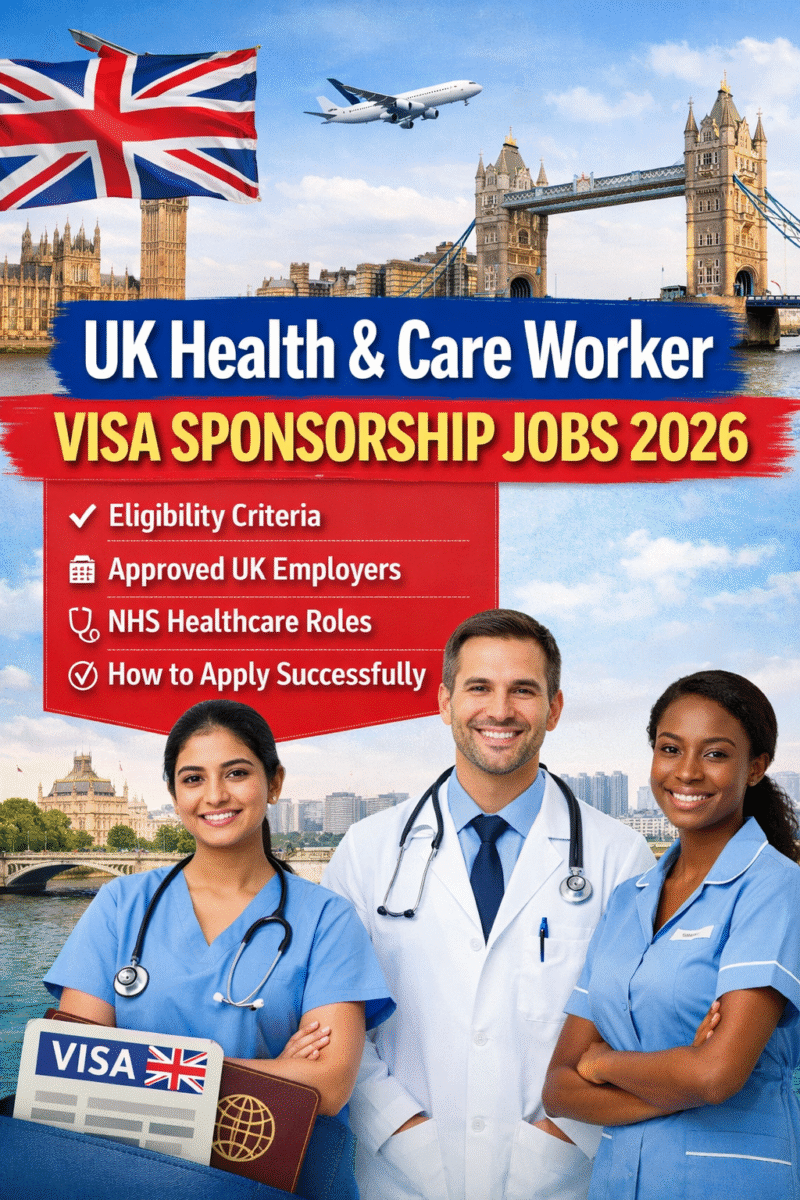
The Health and Care Worker visa is a specialist branch of the UK Skilled Worker route for eligible health and social care professionals. In plain English, it is the UK government’s formal route for qualified workers in approved medical, health, and adult social care roles to take up sponsored employment with approved UK employers. To qualify, you must have an eligible job, work for a Home Office-approved employer, hold a Certificate of Sponsorship, and meet the relevant salary requirement for your role.
What makes this route attractive is not just the right to work in the UK. It is the package around it. The official guidance says Health and Care Visa applicants benefit from reduced visa fees, fast-track entry, dedicated application support, and exemption from the Immigration Health Surcharge for both the main applicant and eligible family members. That is a huge difference compared with many other work routes, where the surcharge alone can feel like a second rent payment before you even land.
The route also remains a path to long-term residence. The official visa guidance says you can extend the visa as many times as needed if you still meet the rules, and after five years you may be able to apply for settlement, also called indefinite leave to remain.
Why So Many People Want This Visa in 2026
There is a reason this visa gets so much attention. It solves three big problems at once.
First, it gives eligible workers a lawful route into the UK labour market through a specific employer. That matters because many people waste time chasing “UK jobs” in general, when the real gatekeeper is not the job title alone but whether the employer can sponsor you and whether the role matches an eligible occupation code.
Second, it can be faster and cheaper than other skilled work routes. UK guidance says Health and Care Visa applications are prioritised, with the aim that the vast majority are processed within three weeks after biometrics are provided. The route also has lower fees than the standard Skilled Worker route and does not require the Immigration Health Surcharge.
Third, the demand is real. On the NHS Jobs portal alone, a search for “Visa sponsorship” returned more than a thousand live results in early March 2026, which shows that sponsorship-linked vacancies are not imaginary. They are out there. The challenge is filtering the real, relevant roles from the noise.
That is why this route still matters in 2026. It is not a lottery ticket. It is a system. If you understand the system, your odds improve dramatically.
Who Can Apply for UK Health & Care Worker Visa Sponsorship Jobs?
The official GOV.UK guidance says this route is for qualified doctors, nurses, health professionals, and adult social care professionals who are taking eligible jobs with approved employers. That means not everyone who works in a hospital, clinic, pharmacy, or care setting qualifies automatically. Your job must fit an eligible occupation code, and your employer must be approved to sponsor you.
This is where many applicants get tripped up. They focus only on job titles. But UK immigration decisions are not built around job titles in a casual sense. They are built around occupation codes, sponsor status, salary thresholds, and whether the role genuinely fits the code chosen by the employer. Think of it like a lock with four pins. A good CV might lift one pin. Your qualification lifts another. But unless the occupation code, sponsor licence, and salary all line up, the door still stays shut.
Broadly, eligible applicants often come from fields such as nursing, medicine, allied health, some laboratory or technical health roles, healthcare management roles, and approved adult social care roles. Care workers and senior care workers can still qualify, but 2026 applicants need to pay close attention to stricter rules around sponsors, salaries, and dependants.
Which Jobs Usually Qualify Under This Route?
The official Health and Care Worker guidance lists eligible occupation codes rather than just a short list of friendly job titles. Those codes include roles such as health services managers, healthcare practice managers, residential and domiciliary care managers, biomedical scientists, physical scientists, laboratory technicians, dispensing opticians, pharmaceutical technicians, care workers and home carers, and senior care workers, among others.
That matters because two roles that sound similar can be treated very differently. For example, “support worker” can mean different things depending on duties, setting, and sponsor classification. Likewise, “care assistant” in marketing language is not automatically the same as a qualifying occupation code in immigration law. The employer must assign the correct code on the Certificate of Sponsorship, and the role must genuinely match that code.
This is why smart applicants do not just search for “UK healthcare jobs.” They search with more precision:
“nurse visa sponsorship UK,”
“senior care worker sponsorship UK,”
“biomedical scientist sponsorship NHS,”
“physiotherapist visa sponsorship UK,”
or “occupational therapist sponsorship NHS.”
That one shift alone can save you weeks of wasted clicks.
One of the biggest mistakes people make is treating all sponsorship jobs in health and care like they operate under identical rules. They do not.
Jobs with NHS trusts, NHS-related bodies, and some regulated health organisations often follow a more structured recruitment pattern. Vacancies are clearer, recruitment stages are more formal, and the employer is usually easier to verify. The NHS Jobs overseas guidance makes clear that the NHS actively welcomes professionally qualified applicants from outside the UK.
Adult social care can also be a valid route, but it needs more caution. The official GOV.UK visa page says that if you are a care worker or senior care worker in England, your employer must be registered with the Care Quality Commission. Caseworker guidance also says the sponsor must currently be carrying out regulated activity and must not be dormant on the CQC register.
That is a huge point.
So if someone tells you they can sponsor you for a care job in England, but the company is not CQC-registered and active for regulated work, that is not a small technicality. That is a flashing red light.
The Salary Rules in 2026: This Is Where Many Applications Rise or Fall
Let’s talk money, because salary is one of the sharpest edges of this route.
For the occupation codes listed under the Health and Care Worker page’s “different salary requirements” section, the rule says you will usually need to be paid at least £31,300 per year, or the lower going rate for your job, whichever is higher. If your role is on the immigration salary list, you may qualify at £25,000 or your job’s full going rate, whichever is higher. In some limited cases, a salary between 70% and 90% of the lower going rate may be allowed if your pay is at least £25,000 and you meet certain criteria, such as being under 26, in professional training, or holding a relevant PhD.
The UK going-rates publication also says these annual salaries are based on a 37.5-hour working week and must be prorated for other patterns. That one sentence matters more than people realise. A salary figure that looks fine at first glance can stop being fine when you divide it across the actual hours stated in your contract.
For care workers and senior care workers, sponsor guidance highlighted a minimum salary of at least £25,000 per year and at least £12.82 per hour for Health and Care visa sponsorship. That is why you should never assess a care offer by annual pay alone. If the hourly rate is too low, the offer can still fail the route requirements even when the yearly figure seems acceptable on paper.
This is the trap: many applicants get emotionally attached to a job offer before checking whether the salary actually works for immigration purposes. Do the immigration math before you celebrate. Not after.
What “Sponsorship” Really Means
A lot of job seekers hear “visa sponsorship” and imagine the employer will simply “help with visa.” That phrase is too vague. In UK immigration practice, sponsorship means the employer is licensed by the Home Office and issues you a valid Certificate of Sponsorship for an eligible job. Without that, there is no real sponsorship, just hopeful conversation.
The Certificate of Sponsorship, often called a CoS, is not a ceremonial letter. It is a formal electronic sponsorship record with your role details, salary, occupation code, sponsor licence details, and start date. The official documents page says you will need your CoS reference number, employer name, sponsor licence number, job title, annual salary, and occupation code when you apply.
That means a genuine sponsor does not just say, “We sponsor.” A genuine sponsor can answer:
What occupation code is this role under?
What is the salary and hourly rate?
Will you assign a Certificate of Sponsorship?
What is your sponsor licence status?
Are you eligible for Health and Care route sponsorship specifically?
If they cannot answer those basics, you are not dealing with a serious process.
Where to Find Real UK Sponsorship Jobs in 2026
If you want to start from the cleanest pool of real jobs, start with the official NHS Jobs website and the official register of licensed sponsors. Those two sources will not hand you success, but they will cut down your exposure to fiction.
The NHS Jobs portal is especially useful for nurses, doctors, allied health professionals, therapists, pharmacists, healthcare scientists, and some support roles. A live search for “Visa sponsorship” on NHS Jobs in March 2026 returned over 1,000 results, which tells you there is real movement in the market.
The sponsor register is your verification tool. It is the government’s list of Worker and Temporary Worker sponsors and includes the category they are licensed to sponsor and their rating. In other words, it helps you answer the question: “Is this employer actually allowed to sponsor workers?”
A smart search workflow looks like this:
You find a job on NHS Jobs or another employer site. Then you check whether the employer appears on the licensed sponsor register. If it is a care role in England, you also check whether the employer is CQC-registered. That three-step check is not glamorous, but it is powerful. It is the difference between job hunting and gambling.
How to Verify a UK Employer Before You Apply
Verification is where many strong candidates protect themselves.
Start with the sponsor register. If the employer is not on the official list, you should assume there is a problem until proven otherwise. The government register exists for a reason. Use it.
Next, if the role is care worker or senior care worker in England, check the Care Quality Commission registration. The official visa guidance explicitly says the employer must be registered with the CQC for those codes in England.
Then check the vacancy itself:
Does it clearly state visa sponsorship?
Does it list salary?
Does it look like a real employer site or a suspicious third-party landing page?
Is the email domain professional?
Are the interview stages normal?
Are they asking you for money before offer or onboarding?
The GOV.UK guidance for overseas health and social care applicants warns about scams and says you should be alert to offers that sound too good to be true. It also warns that if you commit fraud, you risk losing the job, losing regulation, being refused a visa, or being banned from testing in the future.
Here is the blunt truth: real UK employers recruit. Scammers perform. One is a process. The other is theatre.
The Documents You Will Need
When it is time to apply, the official documents page says you will generally need your Certificate of Sponsorship reference number, proof of English, a valid passport, your job title and annual salary, your occupation code, and your employer’s name and sponsor license number. Depending on your situation, you may also need proof of savings, relationship documents for dependants, tuberculosis test results if you are from a listed country, a criminal record certificate for certain jobs, and qualification evidence such as a UK PhD certificate or an Ecctis reference for overseas qualifications.
That list tells you something important: this is not a last-minute application. It is a file-building exercise. Treat it like assembling a clean legal portfolio.
Your paperwork should be orderly, readable, and consistent. If your passport says one spelling, your certificates should not drift into three different spellings. If your bank statements, police clearance, and reference letters tell a story, they should all tell the same story. Immigration casework is often less forgiving than ordinary recruitment.
And yes, English matters. The official visa guidance says applicants must prove they can read, write, speak, and understand English to at least CEFR level B2, usually through an approved route such as a Secure English Language Test if other accepted evidence is not available.
How Much the Visa Costs in 2026
The fee advantage is one of the strongest points of this route.
The Health and Care Worker visa page says applicants must pay the application fee and usually show at least £1,270 in available funds unless exempt, for example where the sponsor covers first-month costs or the applicant has already been in the UK lawfully for at least 12 months.
The same visa route is exempt from the Immigration Health Surcharge, which is a major cost saving because many other UK work routes still attract that charge. Official guidance confirms that Health and Care Visa applicants and eligible family members do not have to pay the surcharge.
Official Home Office fee tables show reduced Health and Care Visa fees compared with standard Skilled Worker fees, with Health and Care applications at £304 for up to three years and £590 for over three years under the 2025 fee schedule that remained current going into 2026 at the time of writing.
That does not mean the move is cheap overall. You may still need money for tests, police clearances, translation, travel, accommodation deposits, and general relocation costs. But compared with the standard Skilled Worker route, the Health and Care route removes one of the heaviest financial stones from the backpack.
How Long the Process Usually Takes
Timing matters, especially if you are coordinating notice periods, exams, family logistics, or relocation.
The government’s Health and Care Visa guidance says UKVI prioritizes these applications, aiming for the vast majority to be processed within three weeks once biometric information has been provided. The GOV.UK visa route also says you can usually apply up to three months before the date your job starts, which is listed on your Certificate of Sponsorship.
If you are already in the UK and extending a Health and Care Worker visa, the official page says you will usually get a decision within three weeks after applying, proving identity, and providing documents, although delays can happen if documents need checking or personal circumstances require further review.
In real life, the entire journey is longer than the visa decision itself. Job search, interviews, offer stage, compliance checks, sponsorship allocation, CoS issuance, and document gathering all take time. The visa decision is the final act, not the whole movie.
Can Your Spouse and Children Come With You? Read This Carefully
This is one of the most sensitive parts of the 2026 route.
The official partner-and-children page says dependants may be able to join Health and Care Worker visa holders, but restrictions now apply to certain categories. For care workers and senior care workers, your partner and children may only be able to apply in limited circumstances, such as where you have been continually employed in the route since before 11 March 2024, where a child was born in the UK, or in certain narrow family situations.
That means many new applicants in care worker and senior care worker roles cannot simply assume they can bring dependants. This is not a minor side note anymore. It is central to planning.
The January 2026 official entry-clearance statistics also show how significant those restrictions were in practice: dependant applications on the route fell sharply after the restrictions introduced in 2024, and numbers remained far below 2023 levels, with 2,600 dependant applications recorded in January 2026.
So before you accept any care-sector offer, ask yourself a hard question: is this role right for my long-term family plan? A job offer is exciting, but if your entire migration strategy depends on immediate dependant access, you need to check the rule position before you build your future around assumptions.
The Best Places to Focus Your Job Search
Let’s get practical.
If you are a nurse, doctor, midwife, physiotherapist, radiographer, pharmacist, biomedical scientist, occupational therapist, speech and language therapist, or another regulated health professional, the NHS ecosystem is often your cleanest first target. The NHS Jobs overseas page clearly states that professionally qualified healthcare staff from outside the UK are welcome to apply.
If you are targeting adult social care, focus on established providers with transparent websites, visible registration, clear pay structures, and a verifiable sponsor trail. Small providers can be genuine, but they require more due diligence.
A useful search pattern is:
official employer site first,
NHS Jobs second,
sponsor register third,
and only then commercial job boards.
Why? Because commercial platforms are like busy markets. Some stalls sell fresh fruit. Some sell plastic fruit sprayed with water to look fresh. You need a way to tell the difference.
How to Make Your CV Stronger for Sponsored Roles
A sponsored-job CV is not the same as a general CV. It must do two jobs at once: impress the employer and reduce immigration friction.
Employers want candidates who can do the work, settle into the role, and pass compliance checks without drama. So your CV should make the following easy to spot:
your profession,
your licence or registration pathway,
your years of experience,
your exact care or clinical setting,
your core duties,
your measurable outcomes,
and your readiness for relocation.
If you are a nurse, do not just say “cared for patients.” Show the ward, specialty, patient load, safety standards, and systems you used. If you are in social care, do not just say “supported vulnerable adults.” Show the care setting, safeguarding responsibilities, moving-and-handling experience, medication support where applicable, record-keeping, and teamwork.
The goal is to sound employable, not decorative.
And if sponsorship is essential for you, say so clearly and professionally. Do not hide it until the last minute. Many employers already know whether they sponsor. You are not saving time by being vague.
How to Write Applications That Actually Get Interviews
Most candidates lose before interview because their application reads like it was sent to fifty employers in one afternoon with the emotional commitment of a spam email.
A stronger approach is simple:
tailor the application to the exact role,
mirror the person specification naturally,
and prove fit with evidence.
If the job asks for compassionate care, safeguarding awareness, teamwork, and communication, then your application should not merely repeat those words like a parrot. It should show them through examples. Anyone can claim to be compassionate. The better move is to say you supported elderly residents with personal care, communicated changes in condition to senior staff, documented care accurately, and worked alongside nurses and family members to improve continuity of care.
That is what employers trust: evidence over adjectives.
For NHS roles, the supporting statement is often where shortlisting is won or lost. Many applicants treat it like an afterthought. That is like dressing well for a wedding and forgetting your shoes. The supporting statement is often where the employer decides whether to keep reading.
How to Avoid Wasting Time on Fake Sponsorship Offers
This deserves its own section because scams target hope.
The official GOV.UK overseas-applicant guidance warns people to be careful about scams and job offers that sound too good to be true. Related guidance also warns that if an organisation charges you for a Certificate of Sponsorship while promising you a visa and job, you should treat it as a potential scam and report it.
Here are the classic danger signs:
they ask for money for sponsorship,
they promise a job without a real interview,
they avoid giving the occupation code,
they cannot explain salary properly,
their company is missing from the sponsor register,
or they push urgency so aggressively that you stop asking sensible questions.
A real recruitment process may move quickly, but it does not collapse under basic due diligence. If asking normal verification questions makes them angry, that is not professionalism. That is exposure.
Treat your passport like your heartbeat. Do not hand it over casually. Do not pay random “agents” for sponsorship slots. Do not buy fake documents. Fraud in immigration is like building a house on sand during rainy season. It may stand for a moment, but it is already falling.
What International Applicants Often Misunderstand
The first misunderstanding is assuming any healthcare-related employer can sponsor. Wrong. The employer must be approved, and the role must be eligible.
The second is assuming any salary offer is good enough if it sounds high in local currency. Also wrong. UK immigration rules care about the route threshold, the occupation code, and in many cases the hourly rate.
The third is assuming “care jobs” automatically allow family relocation. Not anymore for many new care worker and senior care worker applicants.
The fourth is assuming sponsorship means the employer pays every relocation cost. Some do offer strong relocation support, but that is an employer-specific benefit, not a universal immigration entitlement. You must check the actual offer carefully. Some NHS employers and trusts do publish relocation support packages, but you should treat those as employer benefits, not route guarantees.
The fifth is assuming that once you get to the UK, you can do whatever work you want. The visa is tied to sponsored employment, and while additional work may be possible in some cases, it is rule-bound. The official route says additional paid work is allowed only in certain circumstances and may require updating your visa depending on the work and hours involved.
A Practical Step-by-Step Plan to Land a Sponsored Job
Here is the simplest reliable path.
Start by identifying your exact profession and likely occupation code. Do not guess casually. Match your actual duties and qualification level against the official occupation structure.
Next, build a sponsorship-ready CV and supporting statement tailored to UK employers. Highlight regulation, practical duties, safety, teamwork, and communication.
Then focus your search on real channels: NHS Jobs, verified employer sites, and the sponsor register.
Once you find a likely role, verify the employer’s sponsor status. If it is a care role in England, also verify CQC status.
Apply carefully. Do not mass-fire weak applications.
When interview stage comes, ask smart questions: Will this role be sponsored under the Health and Care Worker route? What occupation code is being used? What is the salary and hourly rate? Will you assign a CoS? Those questions make you sound serious, not difficult.
After offer, gather your visa documents early. Passport, English proof, police certificate if needed, TB test where required, finances if applicable, and family evidence if dependants are eligible.
Then submit the visa application accurately. Accuracy is not glamorous, but it is powerful. One small mismatch can cause outsized stress.
Is the UK Still Worth It in 2026?
For the right candidate, yes.
If you are a qualified professional with realistic expectations, the UK still offers a structured pathway, real employers, a recognised visa route, and long-term settlement potential. The official route still allows settlement after five years, and the Health and Care pathway continues to offer fee and surcharge advantages that matter financially.
But worth it does not mean effortless.
The UK is not a magic portal where life becomes perfect on arrival. Housing is expensive in many areas. Registration pathways can be demanding. Work can be intense. Care roles in particular can be physically and emotionally heavy. Yet for many applicants, especially those who approach the move with preparation rather than fantasy, the route still represents something powerful: legal mobility with professional purpose.
That is the key. Not fantasy. Strategy.
How to Think About Long-Term Success, Not Just Visa Approval
A visa approval is not the finish line. It is the starting gate.
Your better question is not only, “Can I get sponsored?” It is also:
Can I thrive in this role?
Can I afford the location?
Does the employer look stable?
Will this job support my long-term professional growth?
Does the route fit my family plan?
That is especially important in 2026 because the route is no longer equally flexible across all health and care job types. Some roles offer stronger family options, clearer professional progression, and more predictable employer structures than others.
A smart migrant strategy is like planting a tree, not chasing fireworks. Fireworks look exciting for a minute. Trees take longer, but they give you shade later.
Conclusion
The UK Health & Care Worker Visa sponsorship route in 2026 is still one of the most practical work routes for eligible health and adult social care professionals, but only if you approach it with precision. You need a real employer, a real sponsor licence, a real eligible role, a real salary match, and a real understanding of today’s rules. If you build your search around official sources like the GOV.UK visa guidance, the licensed sponsor register, and NHS Jobs, you immediately put yourself in a stronger position.
So do not chase every shiny ad you see. Chase clarity. Verify the employer. Understand the occupation code. Check the salary properly. Be realistic about dependants. Build a clean application. That is how ordinary job seekers become successful visa applicants. Not by luck, but by method.
FAQs
1. Can I get a UK Health & Care Worker visa without a job offer?
No. You need a job offer from a Home Office-approved employer and a Certificate of Sponsorship before you can apply under this route.
2. Are care worker jobs still eligible for sponsorship in 2026?
Yes, care workers and senior care workers remain within the eligible framework, but the rules are stricter. In England, the employer must be registered with the Care Quality Commission, and dependant rules are much tighter for many new applicants in these codes.
3. Do Health and Care Worker visa holders pay the Immigration Health Surcharge?
No. Official guidance says Health and Care Visa applicants and eligible family members are exempt from the Immigration Health Surcharge.
4. Where should I look for genuine sponsorship jobs?
Your best starting points are the official NHS Jobs website for live vacancies and the official UK register of licensed sponsors to verify employers.
5. How long does the visa process usually take?
The government says Health and Care Visa applications are prioritised, with the aim that the vast majority are processed within about three weeks after biometrics are provided.